
Progress Summary - Working Group II
Below you will find information and updates on the TAS Working Group II and how they are progressing in finding a solution to effectively budget the UC Merced campus, including:
- Background
- Project Updates
- Strengths and Weaknesses in the Current TAS Model
- Factors impacting TAS Costs
- Identified Drivers of TAS Budgets
- Membership
Background
The UC Merced TAS model underwent multiple iterations, with the latest involving allocating a percentage of tuition net of return to aid to TAS, distributed based on student credit hour production.
- Significant TAS deficits in the Schools of Natural Sciences (SNS) and Social Sciences, Humanities, and Arts (SSHA) have been observed over recent years. This is exacerbated by cost increases due to renegotiated contracts for graduate student labor and Unit 18 instructors.
- Two working groups were initiated in February 2024 to address TAS budgeting within the larger campus budget and the allocation of TAS funds to the three schools under Academic Affairs.
- Working Group 2, reporting to Interim EVC/P Marjorie Zatz and EVC/P Betsy Dumont, has been tasked with summarizing progress on these issues.
Project Updates
Project leads discussed project charges with each committee and gave a high-level overview of TAS budget history and allocations. Working Group 2 established a preliminary set of principles for a revised TAS model.
Principles for a revised TAS model:
- Simplicity and Stakeholder Understanding: The framework should be easy for all stakeholders to understand and explain.
- Faculty Buy-In: It should ensure faculty support and involvement.
- Comprehensive Communication Plan: Changes should be communicated clearly, including purpose, principles, and goals.
- Transparency: The model must be transparent in its allocation and decision-making processes.
- Focus on General Education and Liberal Arts: Acknowledge the importance of general education and liberal arts education.
- Critical Writing Skills: Ensure students acquire critical writing skills through appropriate instruction.
- Competency Development Budgeting: Allocate budget for competency development in general education classes.
- Disciplinary Differences: Account for disciplinary differences and their budgetary implications.
- Flexibility for Disciplinary Differences: Allow for qualifiers, exceptions, and boundary conditions to accommodate disciplinary differences.
- Efficiency Rewards: Reward departments for judicious resource use.
- Equitable Work Allocation: Ensure fair work allocations for graduate students.
- Recognition of Department Contributions: Acknowledge all departments' contributions to the campus mission.
- Integration with Schools: Connect effectively with schools and incorporate their input into the model.
- Iterative Approach: Be adaptable to changes in instructional models and external budget constraints.
- Flexibility for New Programs: Allow for the addition of new programs to the academic portfolio.
- Focus on Student Success and Equity: Directly contribute to student success, retention, and equity gap elimination.
- Data-Driven Decision-Making: Base changes on data regarding student success outcomes.
- Gradual Changes: Implement changes gradually for continuity.
- Accountability: Create accountability with consequences for deficits and incentives for budget adherence.
- Flexibility for Growth: Account for growth within the model.
- School-Level Management: Manage the model at the school level for curricular decisions.
- Consideration for Instructor Populations: Account separately for the unique needs and contributions of different instructor populations.
Strengths and Weaknesses in the Current TAS Model
Strengths: What works well?
-
Uniform Allocation: The current model distributes funds equally across all three schools, maintaining simplicity and straightforwardness.
-
Funding for Liberal Arts and General Education: It ensures funding for liberal arts and the campus general education curriculum.
- Consideration of Student Credit Hours (SCH): While maintaining simplicity, the model recognizes the importance of considering SCH to quantify instructional contributions across units, while also acknowledging disciplinary differences.
- Living Wages and Benefits: The model ensures that unit 18 lecturers and graduate students receive living wages and benefits, reflecting a commitment to fair compensation.
Weaknesses: What do we need to adjust?
- Fiscal Sustainability: The model is not financially sustainable, as recent curriculum changes have only addressed minor deficits, leaving significant unaddressed deficits.
- Uncertainty in Identifying Causes: There is uncertainty regarding whether deficits stem from overspending or underallocation, a question deferred to another working group.
- Inability to Adapt to Campus Changes: The model does not accommodate shifts in the campus academic portfolio due to additions of new schools or academic programs.
- Lack of Consideration for Disciplinary Differences: Instructional requirements and needs vary across disciplines, including accreditation-imposed needs and those of writing and general education courses, which are not accounted for in the current model.
- Inadequate Accounting for Senate Faculty Staffing Levels: Fluctuations in senate faculty staffing levels are not considered, leading to instructional deficits when significant fluctuations occur.
- Mixing of Funding for Different Groups: Funding for graduate students, Unit 18 lecturers, and continuing lecturers serve different purposes, but the current model does not separate funding accordingly.
- Lack of Iterative Revision: The model has not been revised to adapt to changing needs, indicating a need for a comprehensive overhaul.
- Limited Recognition for Lecturers' Contributions: Contributions of lecturers to the budget are not adequately recognized.
- Inadequate Funding to Meet Instructional Demands: The current TAS funding is insufficient to meet the demands of the curriculum delivered.
- Lack of Consideration for Resource Intensity of New Courses: Course development discussions do not sufficiently consider the resource intensity of new courses, leading to potential mismatches between resource availability and course requirements.
Factors Impacting TAS Costs
The committee discussed broad categories of factors impacting TAS costs, reflected in the model below: 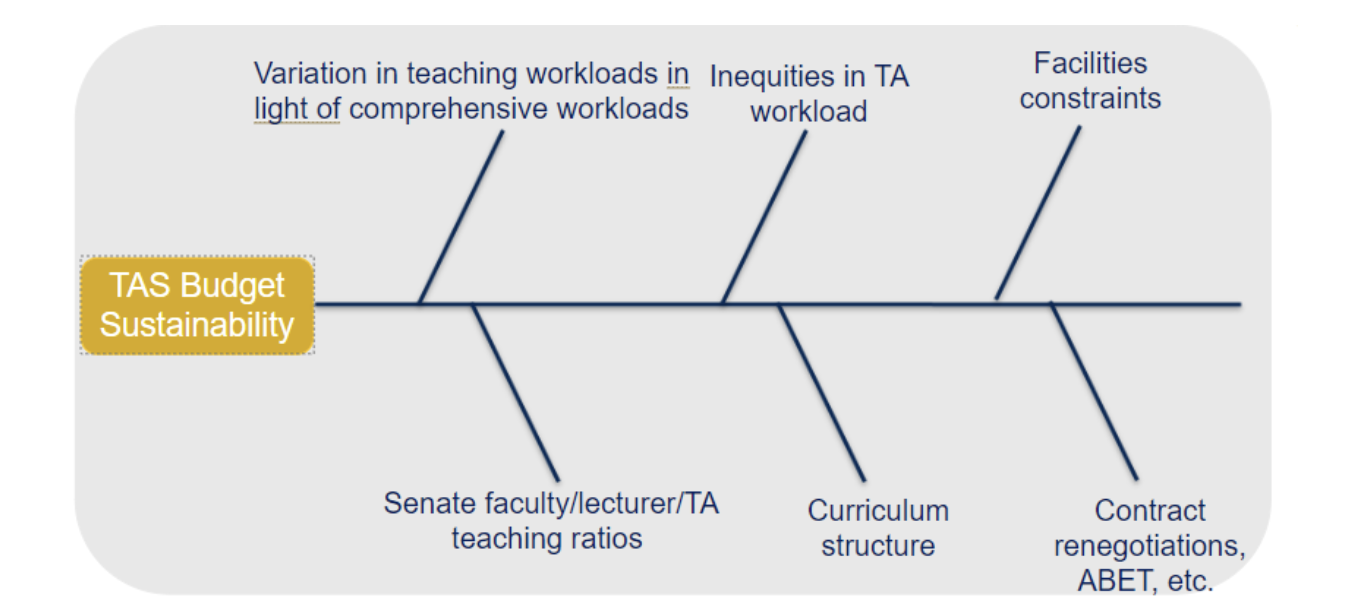
Committee notes and recommendations on Curricular Adjustment Considerations:
Note: Discussion items below and recommendations should be prioritized based on their likely contribution to potential efficiencies.
- Efficiency in Class Sizes: Evaluate where small class sizes are unsustainable and incentivize faculty to adapt pedagogy for larger classes.
- Empirical Analysis of Class Sizes and Student Success: Collect data to understand the impact of class sizes on student success and explore alternative delivery methods.
- Support for Faculty Adaptation: Provide faculty with tools and support to adjust pedagogy for increased efficiency.
- Consideration for Low-Enrollment Majors: Recognize that some majors may not have the option to scale up.
- Efficiency Tools and Analytics: Identify tools to analyze course efficiency and consider procuring analytics software.
- Expanding GE Classes: Evaluate if more classes can qualify as General Education classes to accommodate larger class sizes.
- Addressing Classroom Size Limitations: Explore online delivery methods and alternative classroom arrangements to address size limitations.
- Resource Reallocation: Consider reallocating funds to address financial shortages, such as reallocating fellowship funds to Teaching Assistantships.
- Improved Course Planning: Develop software to model student demand and optimize section enrollment.
- Prerequisite Effectiveness: Assess the effectiveness of prerequisites in improving instructional efficiency.
- Experimental Curriculum Delivery: Cultivate an experimental approach to curriculum delivery, supporting faculty in measurement competencies.
- Encouraging Placement Exams: Encourage students to take placement exams to streamline entry-level course enrollment.
Identified Drivers of TAS Budgets
- TAS Budget Allocations: Influenced by institutional, curricular, work responsibility, facility, and external factors.
- Non-Malleable Factors: Some factors affecting TAS expenditures are not adjustable.
- Malleable Factors: Some factors can be adjusted over time, but not immediately.
- Faculty Perceptions: Curricular modifications depend on faculty perceptions of feasibility.
- Unsustainable TAS Expenditures: Current expenditure levels are unsustainable.
- Optimal Learning Outcomes: Goal is to achieve optimal program outcomes in a cost-effective manner.
- Cost Drivers: Identified in instructional/curriculum delivery, faculty, graduate students, and external factors.
- Curricular Efficiency: Emphasis on adjusting variables to achieve curricular efficiency and reduce TAS expenditures.
Instructional/curricular factors influencing TAS budgets/costs (along with questions where the committee was uncertain on how factors would influence TAS budgets).
- Writing Program and Math 5: Significant cost drivers in the curriculum.
- Class Size Impact: Larger class sizes can lower the need for unit 18s but are limited by enrollment.
- Enrollment and Efficiency: Enrollment is crucial for efficiency potential.
- Fast Degree Completion: Consideration is needed on revenue implications versus student success and faster graduation.
- Small Classes and Electives: Drive up TAS costs, while streamlined paths may increase efficiency.
- Double Majors and Minors: Their role in TAS burden or budget contribution needs examination.
- Lab Classes and Disciplinary Differences: Influence cost of instruction.
- Classroom Availability and Use: Limitations impact large lecture delivery; online classes offer options.
- CRF Mandates and Workload: TA-led sections can affect faculty workload.
- Prerequisite Requirements: Adjusting requirements may affect costs.
- Foundational Classes: Combination of lectures and discussion sections for efficiency.
- Elective Availability: High number of faculty-taught electives linked to costs.
- Supplemental Revenue Streams: Needed to support instruction beyond state funds.
Faculty related factors influencing TAS budgets/costs (along with questions where the committee was uncertain on how factors would influence TAS budgets).
- Instructional Ratios: Influence costs; need for audit to identify efficiencies and gaps.
- Unit 18 Reliance: Major cost driver; augmentation of senate faculty instruction.
- Perceptions of Small Classes: Need examination as they may result in low efficiencies.
- Graduate Student Instruction: Not always cost-effective; reliance on Teaching Fellows can be expensive.
- Course Releases: Drive costs if replacements made with unit 18s; impact parental leave, sabbaticals, etc.
- Resource Allocations: Some units use "same as last year" model; need for questioning given contract changes.
Graduate Student related factors influencing TAS budgets/costs (along with questions where the committee was uncertain on how factors would influence TAS budgets).
- Funding Sources for Grad Students: Include GSR, fellowships, NSF GRF, and philanthropic support.
- Revenue from Master's Students: Tuition-paying master's students could support funding for graduate programs.
- Standardization of Work Responsibilities: Consider standardizing the number of students taught or sections taught per graduate student to enhance equity and efficiency.
- Accounting for Work Hours: Ensure that graduate student labor, equivalent to 20 hours of actual work responsibilities, is properly accounted for given the associated costs.
Membership
Senate Representatives
|
Kevin Mitchell, Senate Vice Chair and CAPRA member, Work Group Co-chair |
|
Christopher Viney, UGC Chair (or designate) |
|
Susan Amussen, Graduate Group Chair, Interdisciplinary Humanities |
|
Jennifer Howell, Graduate Council representative |
Administration Representatives
|
Christiane Spitzmueller, VPAAS, Work Group Co-Chair |
|
Rakesh Goel, SoE Dean |
|
Martin Haggar, Professor, Provost’s Faculty Fellow |
|
Sharon Butler, Assistant EVC/P for Finance |
|
Bianca Khanona, Associate Vice Chancellor, Financial Planning and Analysis, Co-Chair, TAS Budget Work Group |
Work Group Support
|
Jose Lopez, Business Analyst, Center for Institutional Effectiveness (Data and administrative support) |


